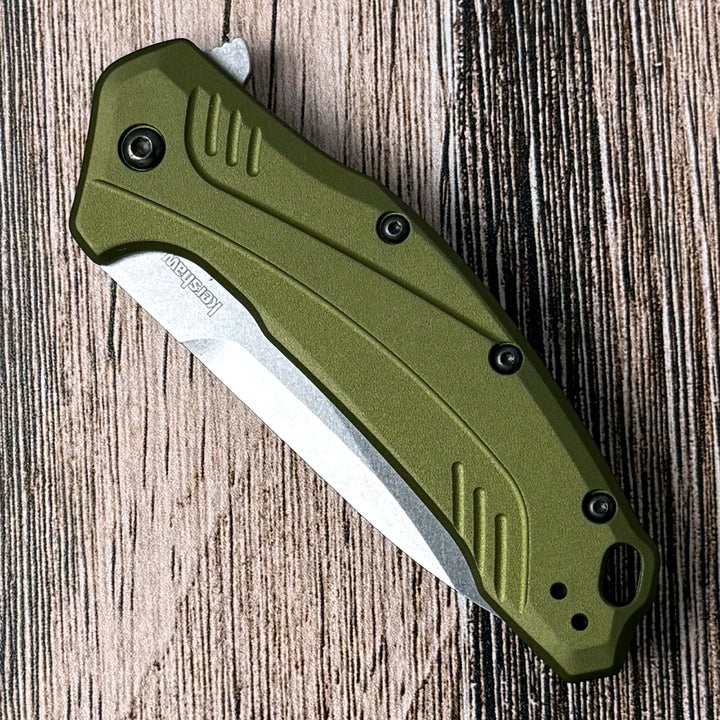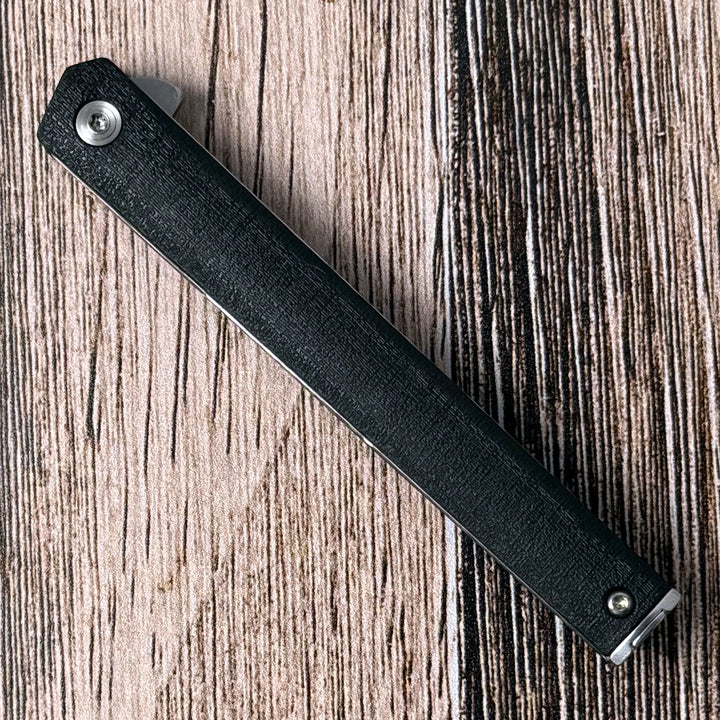
Heads up: We don't currently stock the Kershaw Leek or the CRKT Squid. We've kept this comparison up because the analysis still helps if you're deciding between this style of knife. If you're shopping our catalog, the closest in-stock alternatives are the Kershaw Link (similar size and assisted opening to the Leek) and the Civivi Elementum (compact flipper in the Squid's spirit, with better steel). More options in the "Ready to Order?" section at the bottom.
The Kershaw Leek
Current examples to compare: CRKT CEO.
The Leek has been around since 2002 and it's still a bestseller. That's not an accident.
It's a slender drop-point folder — 4 inches closed, 7 inches open — with a blade that sits flush when closed and deploys fast via Kershaw's SpeedSafe mechanism. One light push on the thumb stud or flipper and it snaps open like it's annoyed at being asked. It's satisfying in a way that's hard to explain until you've used one.
The steel is Sandvik 14C28N, a Swedish stainless that Kershaw has used well for years. It's genuinely good at this price point: holds an edge longer than most budget options, resists rust, and sharpens easily on a basic whetstone or a simple pull-through. You won't find it on high-end custom knives, but for an EDC blade that costs under $50, it punches above its class.
The handle is 410 stainless — slim, smooth, and office-appropriate. This is the knife you can pull out to open a package at your desk without getting weird looks. It doesn't scream "tactical." It looks like a business card holder that happens to cut things.
Pros:
- SpeedSafe assisted opening is genuinely fast and satisfying
- 14C28N steel is noticeably better than budget alternatives
- Slim, professional look — works in almost any environment
- Great clip placement and carry position
- 3" blade hits the legal length limit in most U.S. jurisdictions
Cons:
- Tip can feel delicate if you're rough with it — this isn't a pry bar
- All-metal handle gets slippery when wet; no traction
- Assisted opening mechanism means more moving parts
- Some people find the blade a touch thin for hard-use tasks
Who it's for: Someone who wants a fast, capable, professional-looking folder they're not embarrassed to carry anywhere. Great for office environments, light everyday tasks, and anyone who values a quick, reliable deployment.
---
The CRKT Squid
The Squid is almost comically small. At just 2.95 inches closed and 2.22 inches of blade, it fits in the coin pocket of your jeans without you noticing it's there. That's either its best feature or the reason you'll skip it — depends entirely on what you're carrying it for.
Designed by Lucas Burnley, the Squid's aesthetic is blunt and functional. The blade is a sheepsfoot-influenced drop point. The handle is skeletonized stainless steel with textured scales and a prominent flipper tab that makes one-handed deployment quick once you get the hang of it. It's not assisted, so there's a learning curve compared to the Leek, but the flipper is snappy enough to satisfy.
The steel is 8Cr13MoV, a Chinese stainless you'll find on almost every knife under $30. It does the job. It'll dull faster than 14C28N, and it's more prone to rust if you ignore it — keep it dry, give it the occasional wipe-down, and it handles light EDC tasks without complaint. Just don't expect it to hold an edge for months between sharpenings.
The Squid's frame lock is solid for its price tier. It locks up well with minimal blade play. For a sub-$30 knife, the fit and finish is genuinely impressive.
Pros:
- Extremely compact — fits anywhere, including dress pants
- Excellent value at ~$20–$28
- Frame lock feels robust for the price
- Designed by a respected custom maker (Lucas Burnley)
- Near-invisible pocket presence
Cons:
- 2.22" blade is limiting — some tasks require more reach
- 8Cr13MoV needs more maintenance than premium steels
- Manual opening requires practice; not as fast as assisted
- Small handle can feel cramped for larger hands
- Not ideal as your only knife if you do more than light tasks
Who it's for: Someone who wants an ultracompact backup knife, a first knife they're not worried about, or a minimal daily carry option for light tasks. Also great for anyone who needs to clip a knife to their key ring or slip it in a dress pocket where bulge is a dealbreaker.
---
Head-to-Head
Size & Portability
The Squid wins on pure pocket presence — it's one of the smallest folding knives you can find from a reputable brand. The Leek is slim (seriously slim for a 3" knife), but it's still a full 4 inches closed. If you're wearing slim-fit pants or a suit, that difference matters.
Blade Steel
The Leek takes this clearly. Sandvik 14C28N is a legitimately good steel — better corrosion resistance, better edge retention, cleaner geometry out of the factory. The Squid's 8Cr13MoV is serviceable but noticeably softer. You'll be touching up the Squid's edge more often.
Price
The Squid is the obvious winner here, typically coming in $15–$25 cheaper than the Leek. If budget is the priority, that gap matters. Both are reasonable values for what you get, but the Squid is one of the most capable knives at its price point in the market.
Opening Speed & Feel
The Leek's SpeedSafe mechanism makes it faster and more consistent. The Squid's flipper is decent but requires more deliberate input. For most EDC tasks this doesn't matter much, but if you're opening boxes all day, the Leek's single-handed snap is hard to beat.
Use Case & Versatility
For everyday tasks — mail, packages, food, cord — both work. But the Leek's extra 0.78" of blade gives it more reach and more useful edge length. Once you get into tasks like cutting through thicker cardboard, twine, or rope, the Leek pulls ahead. The Squid is best as a light-duty carry, not an all-purpose tool.
---
Which Should You Buy?
Get the Kershaw Leek if:
- You want one knife that handles everything you throw at it
- You carry in professional or semi-professional environments
- Fast, reliable deployment matters to you
- You're willing to spend a bit more for noticeably better steel
Get the CRKT Squid if:
- You want the smallest knife that still functions as a real knife
- Budget is your primary constraint and you want something under $25
- It's a backup carry or a "just in case" knife
- You need something that fits in a pocket where the Leek won't
The honest take: Most people reading this will be better served by the Leek. It does more, the steel is genuinely better, and it carries cleanly despite being a full 3" blade. It's also not expensive — this isn't a $150 choice between a budget and premium option. It's a $15–$25 question.
That said, if you already have an EDC knife and want something ultracompact for days when you're dressed up, the Squid earns its price every time. And if you're just testing the waters on EDC knives and don't want to commit $40+ before you know how often you'll actually use one, the Squid is a low-risk way to find out. Our guide on [how to choose your first EDC knife](https://mightyoaksupply.com/blogs/edc-guides/how-to-choose-your-first-edc-knife-complete-beginners-guide-2026) walks through exactly this kind of decision if you want more help thinking it through.
If you're still deciding between a few options, we put together a full [roundup of the best budget EDC knives under $50](https://mightyoaksupply.com/blogs/edc-guides/best-budget-edc-knives-under-50-2026) — both of these knives appear on it, alongside a few others worth knowing.
---
Shopping Our Catalog?
We don't currently stock the Kershaw Leek or the CRKT Squid. If you're in the market for this style of knife, here's what we do carry that's closest:
Closest to the Leek (slim, fast deployment, 3" class blade):
— Kershaw Link: Kershaw's SpeedSafe assisted opening, similar slim profile, comparable blade length. Probably the closest like-for-like swap.
— CJRB Pyrite: Premium-feeling budget folder with better steel than you'd expect at the price. Manual flipper rather than assisted, but a clean carry.
Closest to the Squid (compact, budget, backup-friendly):
— Civivi Elementum: Compact flipper, excellent value, one of the most-recommended budget EDC knives for a reason. Better steel than 8Cr13MoV.
— QSP Penguin V2: Budget-friendly, compact, solid lockup. A good pick if you want something small and inexpensive.
Orders ship free in the U.S. and typically dispatched the same day when placed before 5 PM Eastern. Eligible U.S. returns include a prepaid label. See our refund policy for the return window, condition requirements and Canadian return terms.
Shop the picks
The reviewed models are not currently available; these are clearly labeled in-stock alternatives from the same brands or use class. Shop each product on its product page.