
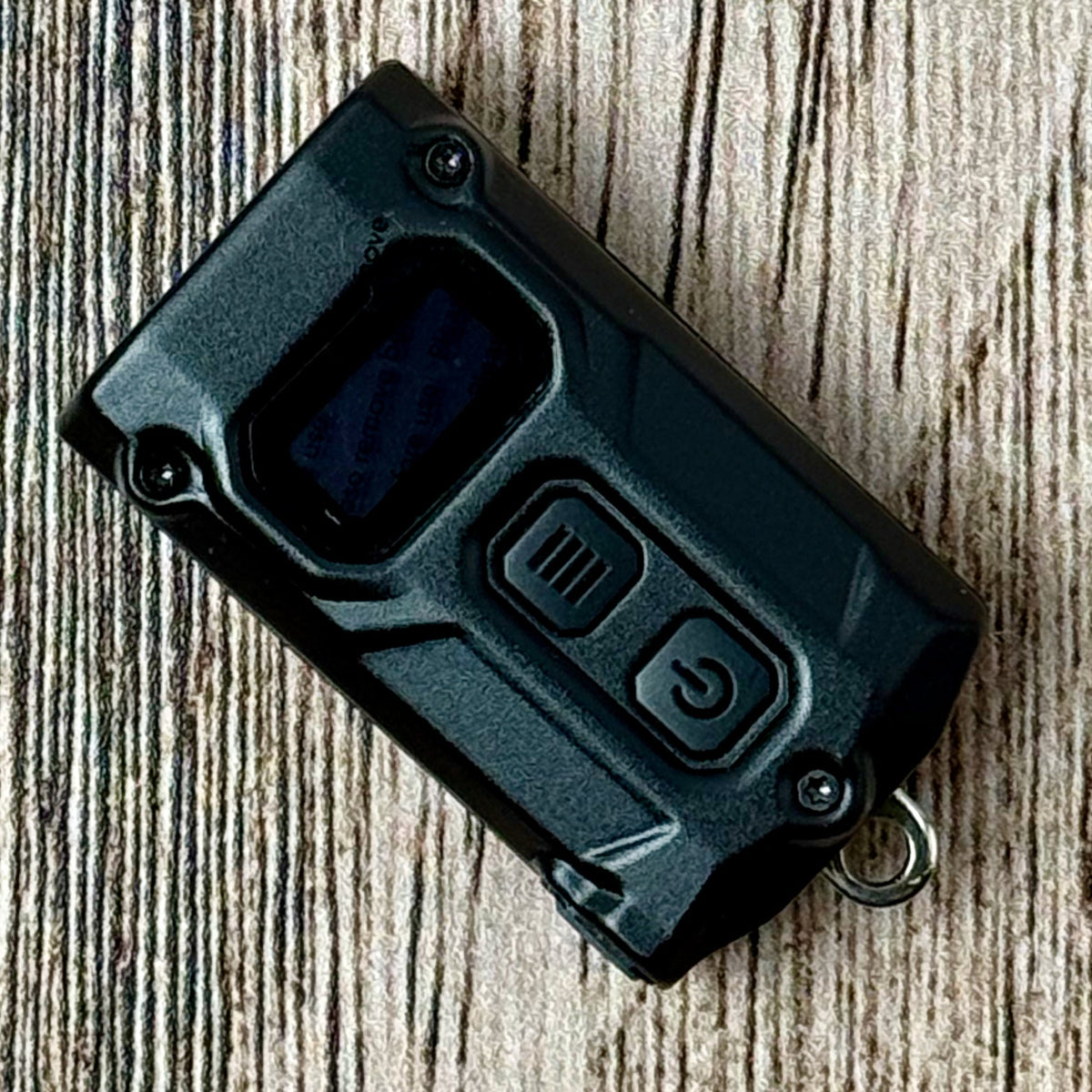
Choose the Nitecore TINI 3 if you want a light that adds very little to your keys. Choose the T4K if you accept a larger body for a much brighter momentary Turbo mode and longer listed runtime at 200 lumens. The important detail: the T4K’s 4,000-lumen maximum is a brief boost, not its normal continuous setting. Both lights have a 200-lumen High mode.
That makes this a more useful comparison than “600 versus 4,000 lumens.” For everyday carry, the size you tolerate, the mode you actually use, and the controls you understand matter more than the largest number on the box.
Nitecore TINI 3 vs. T4K: key specifications
| Feature | TINI 3 | T4K |
|---|---|---|
| Maximum Turbo output | 600 lumens | 4,000 lumens |
| High output | 200 lumens | 200 lumens |
| Listed High runtime | 1 hour | 2 hours 45 minutes |
| Dimensions | 47.2 × 25.4 × 14.0 mm | 82.3 × 30 × 29.2 mm, clip included |
| Weight | 20 g / 0.71 oz, accessories excluded | 77 g / 2.72 oz, clip included |
| Built-in battery | 330 mAh | 1,000 mAh |
| Charging and display | USB-C; OLED screen | USB-C; OLED screen |
| Light color | Selectable warm, neutral, or cool white | White light |
Sources: Nitecore’s TINI3 specifications, T4K specifications, and the manuals linked below. The manufacturer styles the smaller model “TINI3”; Mighty Oak lists it as “TINI 3.” Runtime figures are laboratory ratings, not our test results or a guarantee of unchanged brightness throughout a session.
The TINI 3 is easier to justify on a keyring
The smaller body is the strongest argument for the Nitecore TINI 3 Keychain Flashlight. Its 47.2 mm length is substantially shorter than the T4K’s 82.3 mm, and the published weights put the two lights in different carry categories. The weight figures include different accessories, as noted in the table; they are not measurements of two identical keyring setups.
For finding a dropped item beside a car, checking a lock, or looking into a dark bag, start by asking whether you will keep the light with you. A larger model that gets detached and left on a desk has lost the main advantage of a keychain light.
The T4K is better approached as a small pocket light that can attach to keys. Consider where its body will sit next to your key fob and other tools. If your keyring already feels crowded, our EDC keychain guide can help you decide what earns that space.
Turbo is a boost, not the normal working mode
On both models, you access Turbo by holding the Mode button and return to the previous state when you release it. The T4K manual also describes a Turbo countdown: if you keep holding after it expires, the light drops to High. A hotter light has a shorter available Turbo period.
That is why the Nitecore T4K Quad-Core Keychain Flashlight makes sense when you specifically want a brief burst to look around a dark area. It is a poor purchase if you expect to leave 4,000 lumens running for an entire walk.
The TINI 3 manual likewise treats Turbo as a hold-to-use setting. Its manual flags the maximum Turbo test figures as measured without temperature regulation. For a task that takes several minutes, compare the ordinary brightness levels and runtime instead. Our flashlight selection guide explains the broader relationship between output, runtime, and beam.
Everyday use: runtime and light color
Compare runtime at the brightness you will use
At High, both manuals specify 200 lumens, but list one hour for the TINI 3 and two hours 45 minutes for the T4K. That gives the larger light a practical advantage to consider beyond its Turbo headline. These are manufacturer ratings under test conditions; temperature, battery condition, and how you use the light affect the result.
For a short errand, carrying the smaller light may matter more than extra rated runtime. For repeated tasks across an evening, the T4K’s longer listed High runtime may justify its size. If you regularly need extended lighting, compare dedicated pocket lights or headlamps too, rather than requiring a keyring attachment to solve every job.
Both models recharge through USB-C and have built-in batteries. Build charging into your routine: check the display before leaving, and charge before a task where running out would be inconvenient. A runtime display is helpful information, not a substitute for starting with enough charge.
The TINI 3 adds a choice of light color
The TINI 3 offers 3,000K warm light, 4,500K neutral white, and 6,500K cool white. That lets you choose how the illuminated area looks. If you dislike a cool-looking beam for close work, this is a reason to consider the smaller model that has nothing to do with maximum output.
Color temperature describes the appearance of the light. It does not, by itself, tell you how accurately every color will be rendered. Choose a setting you find comfortable for the task rather than assuming the warmest or coolest option is universally best.
Two settings to learn before pocket carry
- Use full lockout for storage among keys. Both models offer partial and full lockout. Partial lockout still permits Turbo access; full lockout disables activation from both buttons. Follow the manual for your model, because the unlock sequences differ.
- Check the T4K’s user mode. Its default Demo mode shuts the light off after 30 seconds without an operation. Daily mode removes that demo timeout. If a new T4K keeps turning off, check this setting before assuming the battery is faulty.
Keep the beam away from eyes, and do not leave an illuminated light covered in a pocket or bag. Learn the controls at home so you are not discovering them in the dark.
Which one should you carry?
The TINI 3 is our starting recommendation for a light that lives on your keys: its small size and selectable light color suit brief everyday tasks. Choose the T4K when you have a clear use for its momentary boost or longer listed High runtime and are comfortable carrying the larger body. Buy for the mode you will use most, not just the brightest mode available.
Shop the picks
The two Nitecore models compared in this guide.

