
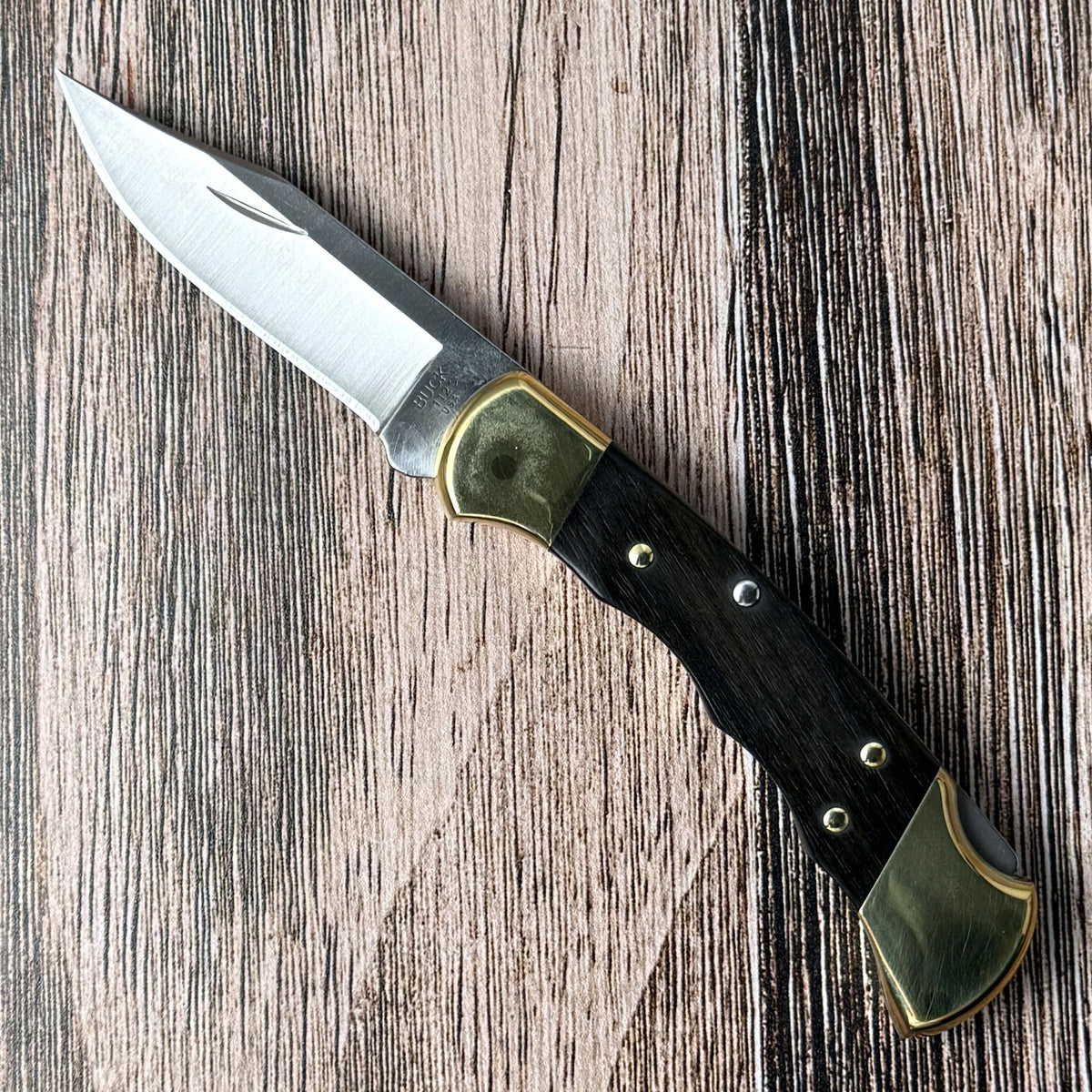
Choose the Buck 112 Ranger for a smaller traditional everyday-carry knife. Choose the Buck 110 Folding Hunter when you want a longer blade and handle and are comfortable carrying the extra weight. The standard 112 has a 3-inch blade and weighs 5.6 ounces; the standard 110 has a 3¾-inch blade and weighs 7.2 ounces. Both combine a manual lockback design with ebony handles and brass bolsters.
The useful question is how much knife you want to carry through an ordinary day. This comparison focuses on the classic, plain-edge, clip-point models. Slim, Sport, automatic, and custom versions can have different materials, weights, opening systems, and carry options.
Buck 110 vs. 112: specifications at a glance
| Feature | Buck 110 Folding Hunter | Buck 112 Ranger |
|---|---|---|
| Blade length | 3¾ in. | 3 in. |
| Closed length | 4⅞ in. | 4¼ in. |
| Knife weight | 7.2 oz. | 5.6 oz. |
| Blade steel | 420HC stainless | 420HC stainless |
| Blade shape | Clip point | Clip point |
| Opening and lock | Manual nail notch; lockback | Manual nail notch; lockback |
| Handle | Genuine ebony; brass bolsters | Genuine ebony; brass bolsters |
| Carry equipment | Leather belt sheath; no pocket clip | Leather belt sheath; no pocket clip |
Dimensions and weights are Buck’s published figures for the standard models, not our own measurements. See Buck’s 110 Folding Hunter specifications and 112 Ranger specifications. Natural wood color and grain vary.
The biggest difference is what you carry
The 112 reduces size and weight
The 112 saves 1.6 ounces and ⅝ inch of closed length compared with the 110. Those are useful reductions when the knife competes with a phone, wallet, keys, and other gear. It is still a substantial brass-and-wood folder, though. “Smaller than a 110” does not mean ultralight.
For opening parcels, cutting cord, and other brief daily cutting jobs, the shorter blade is a sensible starting point. The Buck 112 Ranger keeps the traditional materials and sheath-carry approach in a more compact package.
The 110 gives you more blade and handle
The 110 adds ¾ inch of blade length. That extra reach can be useful when a cut needs more blade to span the material. Its longer handle also gives you a larger footprint to assess for your grip, particularly if smaller handles tend to feel cramped.
The tradeoff is carrying the larger knife between uses. The Buck 110 Hunter makes the most sense when you specifically want a full-size traditional folder and already accept a belt sheath as part of your daily setup. A longer blade alone does not establish greater lock strength or make a folding knife suitable for prying.
Grip fit matters more than the model number
Overall length cannot tell you exactly how a handle will fit your hand. The standard 112 has a more pronounced front guard shape; the 110 has a longer handle with a different outline. Look at the handle profile as well as the dimensions.
If you can handle both before choosing, check these points with the knife closed:
- Finger room: Can your fingers settle naturally without crowding the ends?
- Pressure points: Does a bolster or corner push into your hand when you take a working grip?
- Carry comfort: Does the closed knife fit the pocket or sheath position you actually use?
- Clothing: Will you carry it in work trousers, jeans, or lighter clothing?
For the broader relationship between blade length, handle length, and carry weight, see our pocket knife size guide.
Opening, locking, and everyday convenience
These classic models use a nail notch and a lockback. Plan on deliberate two-handed opening. Neither has the thumb stud or flipper found on many modern EDC folders, and neither standard model includes a pocket clip.
That is a meaningful buying decision if you repeatedly need to open a knife while your other hand holds packaging or material. Set the material down and open the knife with both hands, or choose a design intended for one-handed opening. Do not buy either classic expecting it to behave like a modern clipped folder.
A lockback holds the blade open until the lock is released. Keep fingers clear of the blade’s closing path, and use the knife for cutting rather than twisting or levering. Our knife lock guide explains how this mechanism compares with other common designs.
The shared steel is not a reason to choose the larger knife
Both standard models use 420HC stainless steel. Moving from the 112 to the 110 does not, by itself, buy a different blade steel. For this comparison, size, grip, and carry method do more to separate the knives than the steel label.
Actual cutting performance also depends on the edge’s condition and the material being cut. A neglected edge on the larger knife is no substitute for a sharp edge on the smaller one. Keep either knife clean and dry after use, and maintain the edge rather than waiting for cutting to become difficult. Our pocket knife sharpening guide covers the basic process.
Which Buck should you choose?
Choose the 112 Ranger if…
You want the classic ebony-and-brass construction, most of your cutting is ordinary daily utility work, and reducing the carried size matters more than maximum blade length. Between these two standard models, it is our starting recommendation for everyday carry, provided its handle fits your hand.
Choose the 110 Folding Hunter if…
You want the longer blade, prefer a larger handle, and are happy using a belt sheath. Choose it because those dimensions help your work or fit your preferences, rather than because the larger model must automatically be the better knife.
Consider a different version if…
Your priorities are a pocket clip, lower weight, or one-handed opening. A Slim or Sport model is a separate comparison, and its specifications should be checked individually. The classic 112 Ranger is not the same knife as the 112 Slim. Our pocket knife collection includes traditional and modern carry options.
Frequently asked questions
Is the Buck 112 lighter than the Buck 110?
Yes. Buck lists the standard 112 at 5.6 ounces and the standard 110 at 7.2 ounces. The difference is 1.6 ounces, or about 22% of the 110’s listed weight. That comparison does not apply to every variant bearing those model numbers.
Do the standard 110 and 112 have pocket clips?
No. The standard ebony-and-brass models discussed here come with leather belt sheaths. Check the exact version if you want a factory pocket clip.
Is the Buck 112 simply a smaller 110?
They share the same basic traditional format and listed steel, but the 112 also has a different handle profile. Treat it as a smaller option to assess for your own grip, rather than assuming it will feel exactly like a scaled-down 110.
Product details and Mighty Oak availability checked September 5, 2026. Recommendations are based on manufacturer specifications and carry requirements; this is not a hands-on performance test.
Choose by the size you will use and carry
The Buck 112 Ranger is the more compact choice for traditional everyday carry. The Buck 110 earns its extra size when you want more blade and handle and have a comfortable way to carry it. Start with your grip, your daily cutting tasks, and your preferred carry method; then choose the model that fits those needs.
Shop the picks
The two classic models compared in this guide.

