For most everyday-carry users, a full-flat grind is the best all-purpose starting point: it slices efficiently, works well across common materials, and is easy to understand. Hollow grinds can cut exceptionally well near the edge, saber grinds retain more blade thickness, Scandi grinds excel at controlled woodworking, and convex grinds favor a strong, smooth transition to the edge.
That short answer is useful, but it is not the whole answer. A knife's grind is only one part of its cutting geometry. Blade thickness, thickness behind the edge, edge angle, blade height, steel, heat treatment, and the material being cut can matter just as much. This guide explains the major knife blade grinds, what each one does well, and how to choose without getting trapped by labels.
Knife Blade Grinds at a Glance
| Grind | Basic geometry | Common strengths | Common tradeoffs |
|---|---|---|---|
| Full flat | Straight bevel runs from the spine toward the edge | Low drag, deep slicing, versatile EDC performance | Removes more material than a comparable saber grind |
| Hollow | Concave primary bevel curves inward | Can be very thin behind the edge; excellent shallow slicing | Geometry can thicken quickly higher up the blade |
| Saber | Primary bevel starts partway down the blade | Retains full-thickness stock near the spine | Usually creates more wedging in deep cuts than a full-height grind |
| Scandi | Wide, flat bevel runs to the edge without a separate secondary bevel | Wood carving, field work, easy angle reference | Less efficient in some deep slicing tasks; sharpening removes more steel |
| Convex | Bevel curves outward toward the edge | Strong edge support, smooth transition through material | Harder to reproduce exactly with some guided sharpeners |
| Chisel | Primary bevel is ground mainly or entirely on one side | Specialized cutting, simple geometry, very acute working side | Can steer during straight cuts and may feel unfamiliar |
These are useful categories, not performance guarantees. Two full-flat-ground knives can cut very differently if one has thicker blade stock or much more steel behind the edge.
Blade Grind vs. Blade Shape vs. Edge Bevel
These terms describe different parts of a knife:
- Blade shape is the profile seen from the side: drop point, clip point, tanto, sheepsfoot, Wharncliffe, and similar designs.
- Primary grind is the large bevel that reduces the blade from its original stock thickness toward the cutting edge.
- Edge bevel is the narrow, sharpened bevel at the very edge on most factory pocket knives.
A drop-point blade can be full-flat ground, hollow ground, or saber ground. A hollow-ground blade can still have an ordinary flat secondary edge bevel. That is why blade shape and grind should be compared separately. See our pocket knife blade-shape guide for the profile side of the decision.
There is another important wrinkle: saber describes where the primary grind begins, while flat or hollow can describe the bevel's cross-section. A saber grind is commonly flat, but a partial-height hollow grind is also possible. Product terminology is not perfectly standardized, so use the label as a starting point and inspect the actual geometry.
Full-Flat Grind: The Versatile EDC Choice
A full-flat grind uses a straight primary bevel that extends from the spine, or very near it, down toward the edge. Because the taper uses most of the blade's height, it can reach the edge gradually and move through deep material with relatively little drag.
Best for
- Cardboard, packaging, food, and general utility cuts
- Users who want one practical grind for varied daily work
- Broad blades that provide enough height for a gradual taper
Tradeoffs
A full-flat grind removes more material from the sides of the blade than a comparable saber grind. That does not make it fragile by default; stock thickness, blade height, steel, heat treatment, and edge geometry still determine the real result. It simply means the design gives up some full-thickness material in exchange for a more gradual cutting wedge.
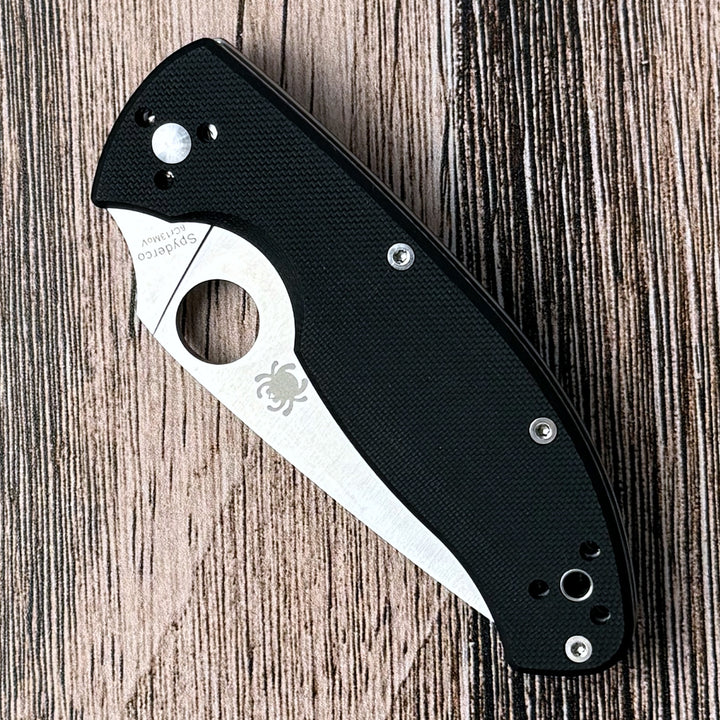
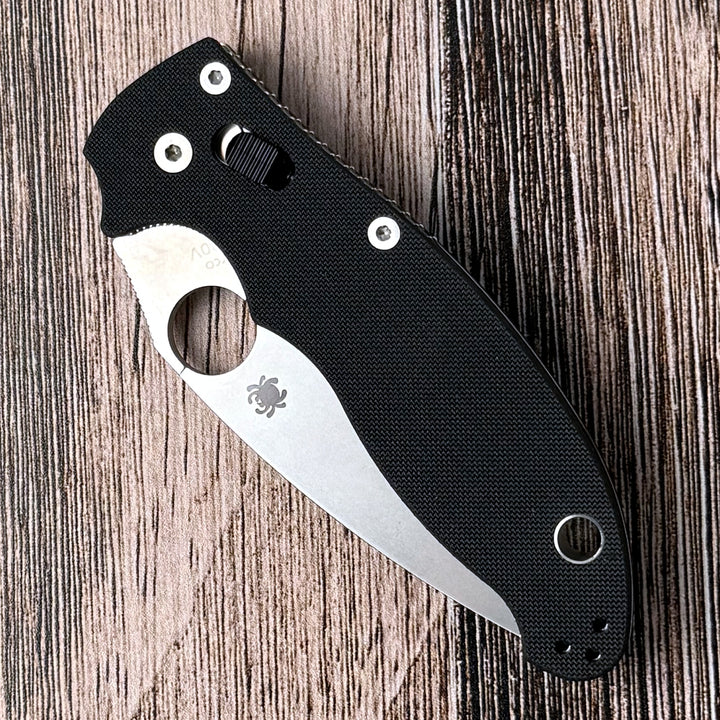
The Spyderco Tenacious is a useful full-flat-ground EDC reference: a broad blade gives the grind room to taper while the design remains a practical everyday folder. The Spyderco Manix 2 uses the same general grind category in a larger, more substantial package. The grind matters, but the difference in blade stock, handle, weight, and overall construction matters too.
Hollow Grind: Thin Near the Edge
A hollow grind is made with concave primary bevels that curve inward before meeting the edge bevel. This geometry can leave very little material directly behind the cutting edge, which is why well-executed hollow grinds can feel extremely sharp and efficient in shallow cuts.
Best for
- Controlled slicing through thin or flexible material
- Skinning and other work that benefits from a keen, thin section near the edge
- Users who value long-term thinness as the edge is sharpened back
Tradeoffs
The curve eventually returns toward full blade thickness. In deep, rigid material, that transition can create more resistance than a gradual full-flat grind. The exact depth and radius of the hollow matter, so "hollow ground" alone does not tell you whether a knife is delicate, durable, thin, or thick.
Do not confuse a hollow primary grind with a recurved cutting edge. The grind describes the blade's cross-section; recurve describes the edge profile seen from the side.
Saber Grind: More Full-Thickness Blade
A saber grind begins partway down the blade, leaving a section near the spine at full stock thickness. The primary bevel may be flat or hollow, although "saber grind" often means a flat saber grind in everyday product descriptions.
Best for
- Work knives that prioritize a stout blade over minimum cutting resistance
- Shorter or narrower blades that cannot support a tall full-flat bevel
- Designs intended to retain more lateral strength near the spine
Tradeoffs
A lower grind creates a more abrupt wedge through thick material. That can increase resistance in cardboard, dense food, and other deep cuts. Saber grinds are often associated with hard use, but the label is not permission to pry, twist, or use a folding knife as a substitute for the correct tool.
Scandi Grind: Controlled Woodworking
A Scandinavian, or Scandi, grind is usually a zero-ground saber geometry: the wide primary bevel continues all the way to the cutting edge without a separate secondary bevel. The broad flat is easy to register against wood and gives the user precise control over carving depth.
Best for
- Wood carving, feather sticks, and bushcraft tasks
- Users who want a large, visible bevel as an angle reference
- Field knives designed around controlled cuts into wood
Tradeoffs
Scandi geometry can wedge more than a full-flat grind in deep cuts through cardboard or food. Sharpening the full wide bevel is conceptually simple, but it removes more metal than touching up a narrow secondary edge bevel. Some manufacturers add a small microbevel, so inspect the knife before assuming every Scandi edge should be sharpened exactly the same way.
Convex Grind: A Supported, Rounded Transition
A convex grind curves outward as it approaches the edge. Instead of an abrupt shoulder between the primary grind and edge bevel, the blade can transition smoothly while keeping more supporting material behind the edge.
Best for
- Outdoor knives, axes, and tools that need strong edge support
- Cutting where a smooth transition through material is valuable
- Users comfortable maintaining a curved bevel by hand
Tradeoffs
Convex geometry is less compatible with sharpeners designed to create one exact flat angle. It can still be maintained with abrasive paper over a slightly yielding surface, careful stone work, or stropping, but preserving the original curve takes practice. A small flat microbevel can be practical, though it changes the original geometry.
Chisel Grind: Specialized and One-Sided
A chisel grind places most or all of the primary bevel on one side of the blade. It can create an acute cutting geometry and is common in certain woodworking, culinary, rescue, and purpose-built tactical tools.
The asymmetry can make the blade steer toward one side during a straight cut. Handedness also matters on some designs. For a first general-purpose EDC knife, a symmetrical grind is usually easier to live with unless a chisel grind serves a specific task you already understand.
Which Blade Grind Is Best for Everyday Carry?
If you do not have a specialized use case, start with a full-flat grind. It is the most balanced choice for the mix of cardboard, plastic packaging, cord, food, and household material that an EDC knife commonly encounters.
| Primary task | Practical starting point | Why |
|---|---|---|
| General everyday carry | Full flat | Balanced performance across shallow and deep cuts |
| Thin material and shallow slicing | Hollow | Can remain very thin immediately behind the edge |
| Stout work-knife geometry | Saber | Retains more full-thickness stock near the spine |
| Wood carving and bushcraft | Scandi | Wide bevel offers control and a clear angle reference |
| Outdoor chopping tools and supported edges | Convex | Rounded geometry supports the edge and reduces abrupt shoulders |
Choose for the work you actually do. A theoretical strength advantage has little value if the knife wedges through the material you cut every day. An extremely thin slicer is also the wrong choice if your normal work damages fine edges.
Five Specifications That Matter Alongside the Grind
- Blade-stock thickness. A thick full-flat blade may still cut with more resistance than a thin saber-ground blade.
- Thickness behind the edge. This strongly affects initial cutting resistance, but brands rarely publish it.
- Edge angle. A more acute edge can cut more easily; a wider edge angle generally provides more support.
- Blade height and shape. A tall blade gives a flat grind more distance to taper. Profile determines tip strength, belly, and cutting reach.
- Steel and heat treatment. Grind geometry determines how the blade meets material; steel and heat treatment help determine how the edge wears, chips, rolls, and resists corrosion.
Use our pocket knife size guide to compare blade and handle dimensions, then consult the pocket knife steel guide for edge retention, toughness, corrosion resistance, and sharpening difficulty. No single specification should make the buying decision by itself.
How Blade Grind Affects Sharpening
On most factory pocket knives, routine sharpening happens at the narrow secondary edge bevel—not across the entire primary grind. A hollow-ground blade does not require a curved sharpening stone, and a full-flat blade does not need its whole side placed on the stone.
- Full-flat, hollow, and saber-ground folders: usually sharpen the edge bevel at a consistent angle.
- Scandi grinds: commonly use the wide primary bevel as the sharpening reference, unless the maker specifies a microbevel.
- Convex grinds: require a motion or surface that preserves the curve rather than replacing it with one broad flat plane.
- Chisel grinds: follow the maker's asymmetrical geometry instead of automatically sharpening both sides equally.
For the complete process, including stones, guided systems, burr removal, and angle control, see our pocket knife sharpening guide. Regrinding the primary bevel is a different operation from routine sharpening and can permanently alter the blade.
Common Blade-Grind Buying Mistakes
- Treating grind labels as rankings. There is no universally best grind independent of the task and the rest of the geometry.
- Confusing shape with grind. Drop point, tanto, and sheepsfoot describe profiles, not cross-sections.
- Assuming every saber grind is flat. Saber primarily describes grind height; check the actual bevel.
- Assuming hollow means fragile. Hollow grinds vary widely in depth, thickness, stock, steel, and edge angle.
- Ignoring behind-the-edge thickness. The same named grind can be executed thin or thick.
- Buying for an imaginary extreme task. Optimize for the material you cut most often, then use the correct purpose-built tool for prying, chopping, or striking.
Frequently Asked Questions
Is a flat grind better than a hollow grind?
Not universally. A full-flat grind is an excellent general-purpose choice and often moves through deep material efficiently. A hollow grind can be thinner immediately behind the edge and excel in shallow slicing. Actual blade thickness, grind height, edge angle, and material matter more than the label alone.
What is the best blade grind for an EDC pocket knife?
For a first general-purpose EDC knife, a full-flat grind is the safest starting recommendation. It offers balanced performance across common daily materials. Choose hollow, saber, Scandi, convex, or chisel geometry when a specific recurring task justifies the tradeoff.
Is a saber grind the same as a Scandi grind?
A Scandi grind is a specialized form of saber geometry. Its flat primary bevel normally continues to the cutting edge without a distinct secondary bevel. A conventional saber-ground pocket knife usually has a separate edge bevel.
Which blade grind is easiest to sharpen?
A conventional secondary edge bevel on a flat-, hollow-, or saber-ground folder is straightforward with a stone or guided system. A Scandi bevel offers an obvious angle reference but requires removing metal across a wider area. Convex and chisel grinds demand technique matched to their geometry.
Can you change a knife's blade grind?
Yes, but a regrind permanently removes blade material and can change strength, cutting behavior, finish, markings, and warranty coverage. Powered grinding also risks overheating the steel. Unless you have the equipment and experience to control geometry and heat, use a reputable professional.
Final Recommendation
Choose a full-flat grind for a versatile first EDC knife, then deviate only when your real work calls for something more specialized. Hollow favors thin cutting near the edge, saber retains more blade stock, Scandi gives control in wood, convex supports demanding edges, and chisel serves specialized cuts.
Most importantly, compare the complete knife. Browse the current pocket knife collection, then evaluate grind, stock thickness, blade shape, steel, size, lock, handle, and carry method together. The best grind is the one that makes your normal cutting easier without creating a tradeoff you notice every day.
Shop the picks
Two in-stock knives already used by the guide to make blade-grind differences concrete.